 Add to Chrome
 Add to Firefox
 Add to Edge
Representation-Regularized Convolutional Audio Transformer for Audio Understanding
Jan 29, 2026
Bootstrap-based Self-Supervised Learning (SSL) has achieved remarkable progress in audio understanding. However, existing methods typically operate at a single level of granularity, limiting their ability to model the diverse temporal and spectral structures inherent in complex audio signals. Furthermore, bootstrapping representations from scratch is computationally expensive, often requiring extensive training to converge. In this work, we propose the Convolutional Audio Transformer (CAT), a unified framework designed to address these challenges. First, to capture hierarchical audio features, CAT incorporates a Multi-resolution Block that aggregates information across varying granularities. Second, to enhance training efficiency, we introduce a Representation Regularization objective. Drawing inspiration from generative modeling, this auxiliary task guides the student model by aligning its predictions with high-quality semantic representations from frozen, pre-trained external encoders. Experimental results demonstrate that CAT significantly outperforms baselines on audio understanding benchmarks. Notably, it achieves competitive performance on the AudioSet 20k dataset with 5 times faster convergence than existing methods. Codes and checkpoints will be released soon at https://github.com/realzhouchushu/CAT.

SLM-SS: Speech Language Model for Generative Speech Separation
Jan 27, 2026Speech separation (SS) has advanced significantly with neural network-based methods, showing improved performance on signal-level metrics. However, these methods often struggle to maintain speech intelligibility in the separated signals, which can negatively affect the performance of downstream tasks such as speech recognition. In this work, we propose SLM-SS, a novel approach that applies speech language models to SS, aiming to enhance the intelligibility and coherence of the separated signals. We frame SS as discrete multi-codebook sequence generation, using Encoder-Decoder models to map quantized speech mixtures to target tokens. In addition to the autoregressive modeling strategy, we introduce a non-autoregressive model to improve decoding efficiency for residual tokens. Experimental results on the LibriMix dataset demonstrate that our approach shows significantly better preservation of speech intelligibility, leading to improved linguistic consistency in a variety of downstream tasks compared to existing approaches.
ICASSP 2026 URGENT Speech Enhancement Challenge
Jan 20, 2026The ICASSP 2026 URGENT Challenge advances the series by focusing on universal speech enhancement (SE) systems that handle diverse distortions, domains, and input conditions. This overview paper details the challenge's motivation, task definitions, datasets, baseline systems, evaluation protocols, and results. The challenge is divided into two complementary tracks. Track 1 focuses on universal speech enhancement, while Track 2 introduces speech quality assessment for enhanced speech. The challenge attracted over 80 team registrations, with 29 submitting valid entries, demonstrating significant community interest in robust SE technologies.
USE: A Unified Model for Universal Sound Separation and Extraction
Dec 24, 2025Sound separation (SS) and target sound extraction (TSE) are fundamental techniques for addressing complex acoustic scenarios. While existing SS methods struggle with determining the unknown number of sound sources, TSE approaches require precisely specified clues to achieve optimal performance. This paper proposes a unified framework that synergistically combines SS and TSE to overcome their individual limitations. Our architecture employs two complementary components: 1) An Encoder-Decoder Attractor (EDA) network that automatically infers both the source count and corresponding acoustic clues for SS, and 2) A multi-modal fusion network that precisely interprets diverse user-provided clues (acoustic, semantic, or visual) for TSE. Through joint training with cross-task consistency constraints, we establish a unified latent space that bridges both paradigms. During inference, the system adaptively operates in either fully autonomous SS mode or clue-driven TSE mode. Experiments demonstrate remarkable performance in both tasks, with notable improvements of 1.4 dB SDR improvement in SS compared to baseline and 86\% TSE accuracy.
Improving Speech Enhancement with Multi-Metric Supervision from Learned Quality Assessment
Jun 13, 2025Speech quality assessment (SQA) aims to predict the perceived quality of speech signals under a wide range of distortions. It is inherently connected to speech enhancement (SE), which seeks to improve speech quality by removing unwanted signal components. While SQA models are widely used to evaluate SE performance, their potential to guide SE training remains underexplored. In this work, we investigate a training framework that leverages a SQA model, trained to predict multiple evaluation metrics from a public SE leaderboard, as a supervisory signal for SE. This approach addresses a key limitation of conventional SE objectives, such as SI-SNR, which often fail to align with perceptual quality and generalize poorly across evaluation metrics. Moreover, it enables training on real-world data where clean references are unavailable. Experiments on both simulated and real-world test sets show that SQA-guided training consistently improves performance across a range of quality metrics.
Interspeech 2025 URGENT Speech Enhancement Challenge
May 29, 2025There has been a growing effort to develop universal speech enhancement (SE) to handle inputs with various speech distortions and recording conditions. The URGENT Challenge series aims to foster such universal SE by embracing a broad range of distortion types, increasing data diversity, and incorporating extensive evaluation metrics. This work introduces the Interspeech 2025 URGENT Challenge, the second edition of the series, to explore several aspects that have received limited attention so far: language dependency, universality for more distortion types, data scalability, and the effectiveness of using noisy training data. We received 32 submissions, where the best system uses a discriminative model, while most other competitive ones are hybrid methods. Analysis reveals some key findings: (i) some generative or hybrid approaches are preferred in subjective evaluations over the top discriminative model, and (ii) purely generative SE models can exhibit language dependency.
Scale This, Not That: Investigating Key Dataset Attributes for Efficient Speech Enhancement Scaling
Dec 19, 2024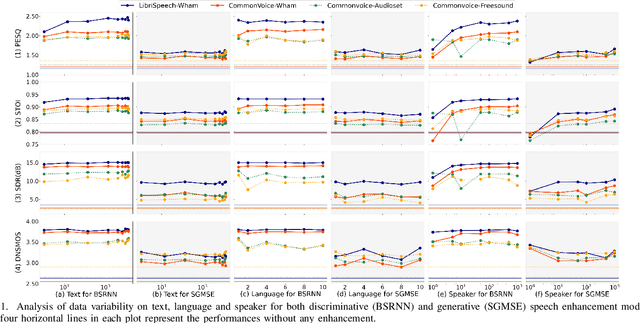
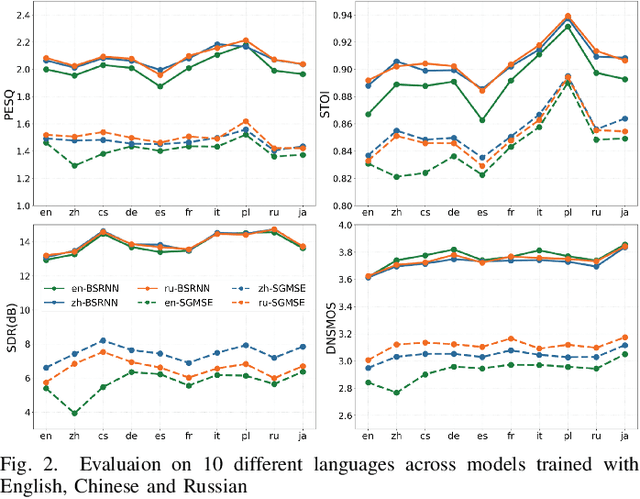
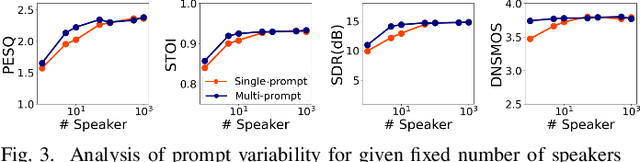
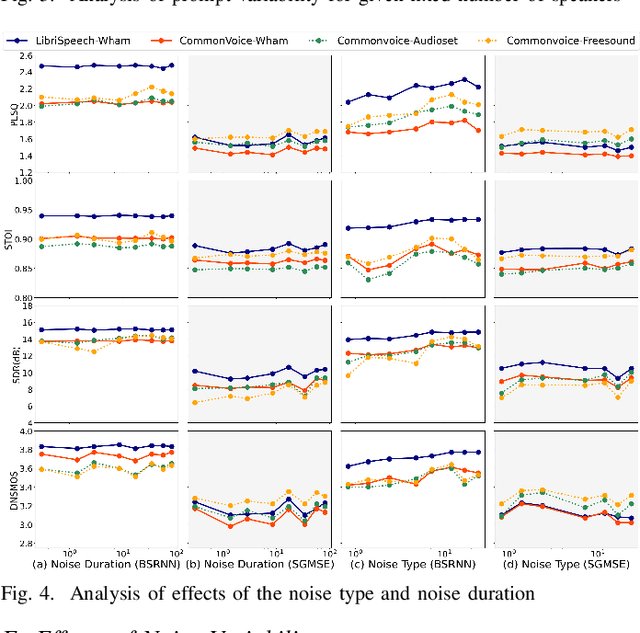
Recent speech enhancement models have shown impressive performance gains by scaling up model complexity and training data. However, the impact of dataset variability (e.g. text, language, speaker, and noise) has been underexplored. Analyzing each attribute individually is often challenging, as multiple attributes are usually entangled in commonly used datasets, posing a significant obstacle in understanding the distinct contributions of each attribute to the model's performance. To address this challenge, we propose a generation-training-evaluation framework that leverages zero-shot text-to-speech systems to investigate the impact of controlled attribute variations on speech enhancement performance. It enables us to synthesize training datasets in a scalable manner while carefully altering each attribute. Based on the proposed framework, we analyze the scaling effects of various dataset attributes on the performance of both discriminative and generative SE models. Extensive experiments on multi-domain corpora imply that acoustic attributes (e.g., speaker and noise) are much more important to current speech enhancement models than semantic attributes (e.g., language and text), offering new insights for future research.
Diffusion-based Generative Modeling with Discriminative Guidance for Streamable Speech Enhancement
Jun 19, 2024
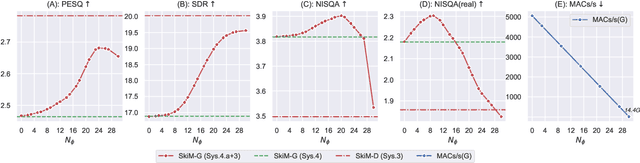
Diffusion-based generative models (DGMs) have recently attracted attention in speech enhancement research (SE) as previous works showed a remarkable generalization capability. However, DGMs are also computationally intensive, as they usually require many iterations in the reverse diffusion process (RDP), making them impractical for streaming SE systems. In this paper, we propose to use discriminative scores from discriminative models in the first steps of the RDP. These discriminative scores require only one forward pass with the discriminative model for multiple RDP steps, thus greatly reducing computations. This approach also allows for performance improvements. We show that we can trade off between generative and discriminative capabilities as the number of steps with the discriminative score increases. Furthermore, we propose a novel streamable time-domain generative model with an algorithmic latency of 50 ms, which has no significant performance degradation compared to offline models.
URGENT Challenge: Universality, Robustness, and Generalizability For Speech Enhancement
Jun 07, 2024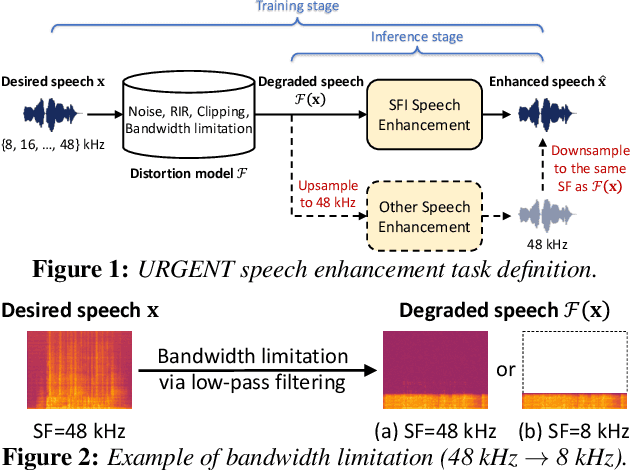


The last decade has witnessed significant advancements in deep learning-based speech enhancement (SE). However, most existing SE research has limitations on the coverage of SE sub-tasks, data diversity and amount, and evaluation metrics. To fill this gap and promote research toward universal SE, we establish a new SE challenge, named URGENT, to focus on the universality, robustness, and generalizability of SE. We aim to extend the SE definition to cover different sub-tasks to explore the limits of SE models, starting from denoising, dereverberation, bandwidth extension, and declipping. A novel framework is proposed to unify all these sub-tasks in a single model, allowing the use of all existing SE approaches. We collected public speech and noise data from different domains to construct diverse evaluation data. Finally, we discuss the insights gained from our preliminary baseline experiments based on both generative and discriminative SE methods with 12 curated metrics.
Beyond Performance Plateaus: A Comprehensive Study on Scalability in Speech Enhancement
Jun 06, 2024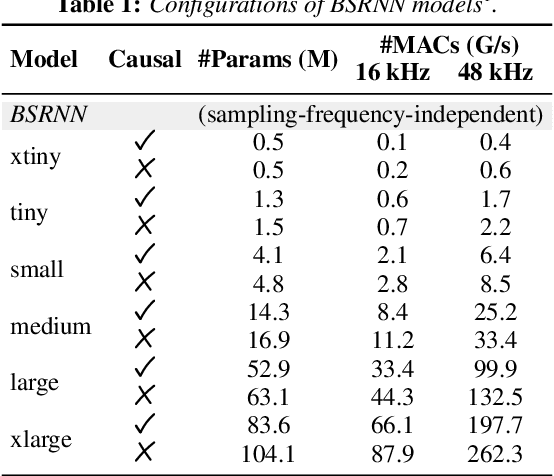


Deep learning-based speech enhancement (SE) models have achieved impressive performance in the past decade. Numerous advanced architectures have been designed to deliver state-of-the-art performance; however, their scalability potential remains unrevealed. Meanwhile, the majority of research focuses on small-sized datasets with restricted diversity, leading to a plateau in performance improvement. In this paper, we aim to provide new insights for addressing the above issues by exploring the scalability of SE models in terms of architectures, model sizes, compute budgets, and dataset sizes. Our investigation involves several popular SE architectures and speech data from different domains. Experiments reveal both similarities and distinctions between the scaling effects in SE and other tasks such as speech recognition. These findings further provide insights into the under-explored SE directions, e.g., larger-scale multi-domain corpora and efficiently scalable architectures.